We planned our trip around the Jewish Cultural Festival in Krakow, and we were there for the last three days of the 33rd year of the two-week event. It’s time for a little Jewish Geography. Dr. Benjamin Sax was a counselor at Capital Camps for a couple of years when he was an undergraduate student. We’ve kept in touch, mostly on social media. When I told him of my trip to Poland he shared that Michael Schudrich, the chief rabbi of Poland, was his first cousin, and he made introductions by email. Rabbi Schudrich put us in touch with Sebastian Rudol at the Krakow JCC who invited us to join 650 other people for Shabbat dinner our first night (for a $90 donation to the JCC. During our exchanges Sebastian told me his sister worked on a project with the last camp director at Capital Camps, Lisa Handelman. It’s all Jewish Geography!
Rabbi Michael Schudrich, Chief Rabbi of Poland
We met the rabbi at dinner. He was a down-to-earth,
self-deprecating, funny gentleman.
A table was set for those Israelis still being held hostage in Gaza.
The dinner was the culminating activity for those who participated in
the Ride for the Living from Auschwitz to Krakow.
They feed 650 people buffet style in less than 30 minutes.
That’s chicken schnitzel, potatoes, and eggplant casserole.
We were seated with a family from New York City traveling with
some teachers from the Collegiate School.
Kazmierz was originally a separate city from Krakow dating to the 14th century. It was founded by King Casimir the Great (Kazimierz Wielki) to protect Krakow, the capital of Poland. Eventually, Kazimierz became a Jewish city when the medieval king invited Jews from all over Europe to settle there where they were encouraged to provide their services and open shops, giving them land and freedom from taxes for four years. Ever since then it has primarily been a Jewish community with over 65,000 Jews at the start of World War II. 90% of the Jews were murdered during the Holocaust and very few survivors stayed after the war. In the 1980s there was a movement to bring the Jewish community back to Krakow, including encouraging local Poles to discover if they have Jewish roots and, if so, to return to Judaism. Today there are about 25,000 Jews living in Krakow, and it has been the site of the Jewish Cultural Festival for 33 years.
Our tour guide, Eliza, picked us up at our hotel and we took a tram to Kazmierz. As we made our way to the Jewish Cemetery, I discovered a city where Jewish culture and history is everywhere, including Jewish restaurants, museums, synagogues, and murals, many of which were part of the Jewish Culture Festival over the years. These are a few pictures that represent Jewish life in Kazmierz.
Our tour guide, Eliza, took us by tram to Kazmierz
There used to be a mikveh (ritual bath) in the basement here, now a Jewish restaurant and book store.
The mikveh deteriorated beyond repair.
One of the several murals adorning Kazmierz.
Previously a beit midrash or school
Poster for a cheder or primary school
Tree of Life surrounded by dreidel
A beautiful alley with upscale stores and restaurants
Used in Schindler's List for the street where victims marched out of the ghetto
and man were killed, leaving belongings behind.
The same alleyway.
The stairs are still there, but I didn't get them in the photograph.
A former shul, now a cafe and performance venue.
Original artwork was left on the walls.
Klemzer Festival Poster
Poster of some of the remaining hostages on the gates of the Krakow JCC
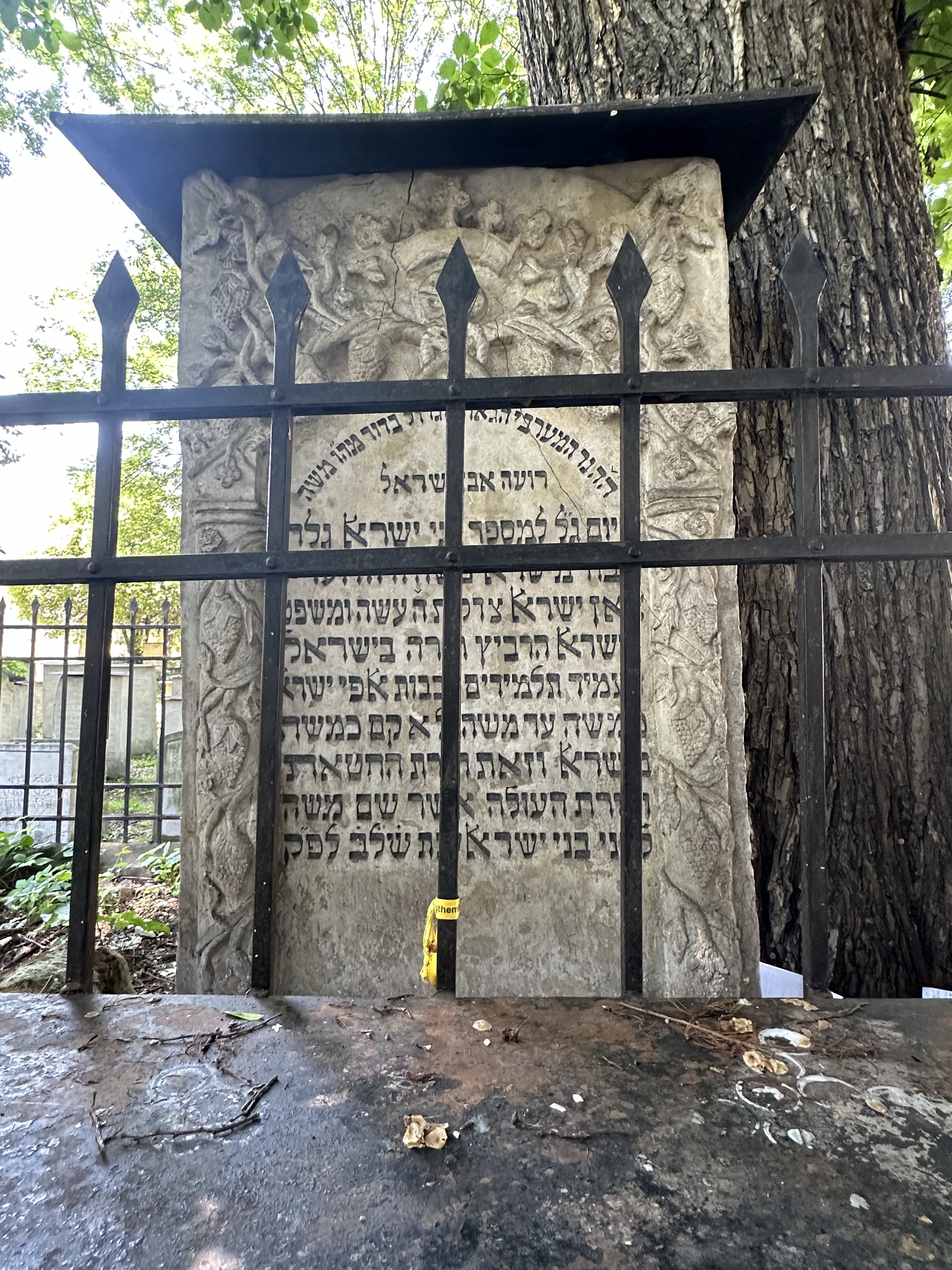
The New Jewish Cemetery was founded in 1800. The older two cemeteries were inside of the ghetto and are no longer extant. Many of the valuable headstones were used by the Nazis as building materials during the war, including Amon Goth who used them to lay the pavement for his courtyard as seen in Schindler's List. The cemetery is about 11 acres. Like most Jewish cemeteries in Poland it also serves as a memorial to those killed during World War II. It remains an active cemetery. As we walked through the gates there were several monuments to the victims of the Holocaust. The modern matzevot are made of granite, but the older ones were sandstone and difficult to read. In addition, as ivy covers the older stones, it cannot be removed by law, so some of the sections of the cemetery seem to be buried in a sea of ivy.
Gate to the New Jewish Cemetery (1800)
Holocaust Memorial
Cemetery Row
Headstones overgrown with ivy
Broken tombstones along the exit
The Remuh Synagogue is one of the smallest synagogues in Kazmierz, built in the 16th century as a private house of workshop. The synagogue is named for Rabbi Moses Isseries (circa 1525-1572), known by the Hebrew acronym of ReMA or Ramah in English, as in Camp Ramah. It is one of two active synagogues in the district. During the Holocaust the Germans used the building as a storehouse for firefighting equipment, thus saving it from demolition, although all of the religious items were destroyed, including the bimah. The synagogue was restored to its original design in 1957.
The Remuh Synagogue
Old cemetery attached to the synagogue
We met a group of American students from USY visiting.
Rabbi Moses Isseries, aka ReMa (Ramah)
Interesting metal bins for yahrzeit candles
Aron HaKodesh
Bimah
Window view
Tempel Synagogue is an active place of worship and a center of Jewish culture. It hosted several events during the festival as well as others year-round. The structure is built in the Moorish Revival style between 1860 and 1862. The synagogue is so names because it was inspired by the Leopoldstadter Tempel in Vienna, Austria. The name many sound familiar if you saw the striking Broadway show, Leopoldstadt. Poland has been occupied by several empires, including the Austro-Hungarian Empire at the time of its construction. During the Nazi occupation the synagogue building was used for storing ammunition, and like the Remuh Synagogue, the building remained but its interior was destroyed. The synagogue went under massive restoration between 1995 and 2000.
Moorish Revival Tempel Synagogue
An interior view from the Aron HaKodesh
The columns and railings are painted with gold leaf.
Stained-glass windows on the women's side
Up-close view of the stained glass windows with memorial names of benefactors
Dining in Kazmierz
We had dinner in Kazmierz three of our four evenings, with the first being the Jewish Culture Festival Shabbat. As we were finishing our Jewish walking tour we passed a new restaurant, Kaplony i Szczezuje, modern Polish Jewish dining that our guide said was one of the best, so we booked a table for the following evening after our visit to Auschwitz-Birkenau. We met one of the owners who explained that she and her partner wanted to bring modern cuisine to traditional Jewish meals. One our last night we went to a traditional Jewish restaurant, Klezmer Hois, for a three-course dinner and klezmer music. It was two nights of great contrast, both delicious.
Modern Polish Jewish Cuisine
Chopped herring salad
Chopped lamb schnitzel with potatoes
Pascha — cottage cheese, raisins, dates, and figs
Gefilte fish
Trout and kugel