Sunday, June 23, 2024

Jewish Vilnius

We had a six-hour walking and driving tour of Jewish Vilnius that included Cathedral Square, the small and large ghetto, and the Paneriai Memorial, with our guide Svetlana, a young Jewish woman from Vilnius. Svetlana's mother was two-years old at the start of the war, and, when the ghetto was liquidated, they were able to get her out and into the home of a Polish family who raised her from 2 to about 6-years old. No one else in her family survived. When the war ended, the Lithuanian Jewish community wanted to give the children saved by Righteous Gentiles the chance to rejoin the community, so, her mother, like many others, was sent to a Jewish orphanage and raised in the religion of her birth. Her father, a Russian, survived because his father had endured the war as a member of the Soviet army. Today, her family, like most others in Vilnius, celebrates the Jewish holidays and consider themselves Jewish but do no participate in the only surviving synagogue, the Orthodox Vilnius Choral Synagogue where we attended services the prior evening.


Vilnius Choral Synagogue


Our tour started with a leisurely walk from our hotel to Cathedral Square and the Vilnius Cathedral. It might seem a strange place to begin, but our Svetlana wanted to show us an unusual statue for a Catholic cathedral -- Moses. The sculptor based his design on Michelangelo's Moses with the two horns, a misinterpretation of the Hebrew word cornuta, which means both horns and, according to our guide and other sources, rays of sun, a more likely translation.


Moses, one of the several statues on the portico 
of the Vilnius Cathedral


We continued our tour with a stroll to the entrance of the small ghetto. On September 6, 1941 the local police and German soldiers rounded up every Jew and imprisoned them into a space of a few blocks. Unlike most round-ups of Jews who were given notice to ready themselves, the Jews of Vilnius were given 15 minutes to gather what they could hold and move, although there wasn't really any place for them to live. Residents of the area were forced to take in several families each. Svetlana explained that it was easy to escape the ghetto, but there was nowhere to go. The ghetto was liquidated on September 23, 1943. 


A map of the Vilnius Jewish ghetto
Small ghetto is the top right and the large ghetto is to the bottom center.


At the entrance to the small ghetto
Murals around the area depict life in the ghetto


A photo of a Jewish merchant in the ghetto area before the war


The same door today


We entered the large ghetto in Zydu Street or Jewish Street. There we came upon a memorial to Vilniaus Gaonui Elijahu. Gaonui means "genious," a nickname given to him because he had a photographic memory and, most importantly, promoted independent study. Since he thought secular knowledge was more important than studying the Torah, he was a controversial figure. He believed in finding the truth in the Torah rather than accepting it at face value. 


Elijas Ben Saliamonas Zalman
The Genius of Vilnius


The Stumbling Stones project has taken root all across Europe, including the Baltics. Memorial bronze tiles are placed in front of the homes or businesses of victims of the Holocaust. In this case, the stones which represent Lazar Lewando and Fania Lewando-Fiszelewicz sit in front of what used to be Fania's vegetarian restaurant, Dieto-Jarska, or Vegetarian Bistro. She was well known for her excellent cooking and compiled her recipes in a cookbook, Vegetarian Cookbook: 400 Meals Made Exclusively from Vegetables in 1938. The artist Marc Chagall signed a guest book. In 1941 Lazar and Fania attempted to escape the Nazis, only to be captured and killed, according to Svetlana. Other sources suggest they were captured by the Soviet army and that their fate is uncertain.


Lazar Lewando and Fania Lewando-Fiszelewicz


The Yiddish cover of Fania's cookbook


The book was rediscovered and republished with a forward by Joan Nathan 


Lazar's and Fania's Stumbling Stones


I was particularly intrigued to discover that, despite being horribly overcrowded, the ghetto had a library that also offered music, dance, theater, and lectures in addition to the books. Currently the building is under renovation to be turned into a local museum of the ghetto. In the exterior are enlarged photos found in the ghetto after its liquidation. Most of the people in the pictures have never been identified. 


Construction has begun on the new museum to be located in the ghetto library.
Estimated completion is 2026.


In addition to the library, the ghetto also had a secret synagogue. That building is no longer extant, but you can see the hand-carved Star of David on the concret part of the wall. 


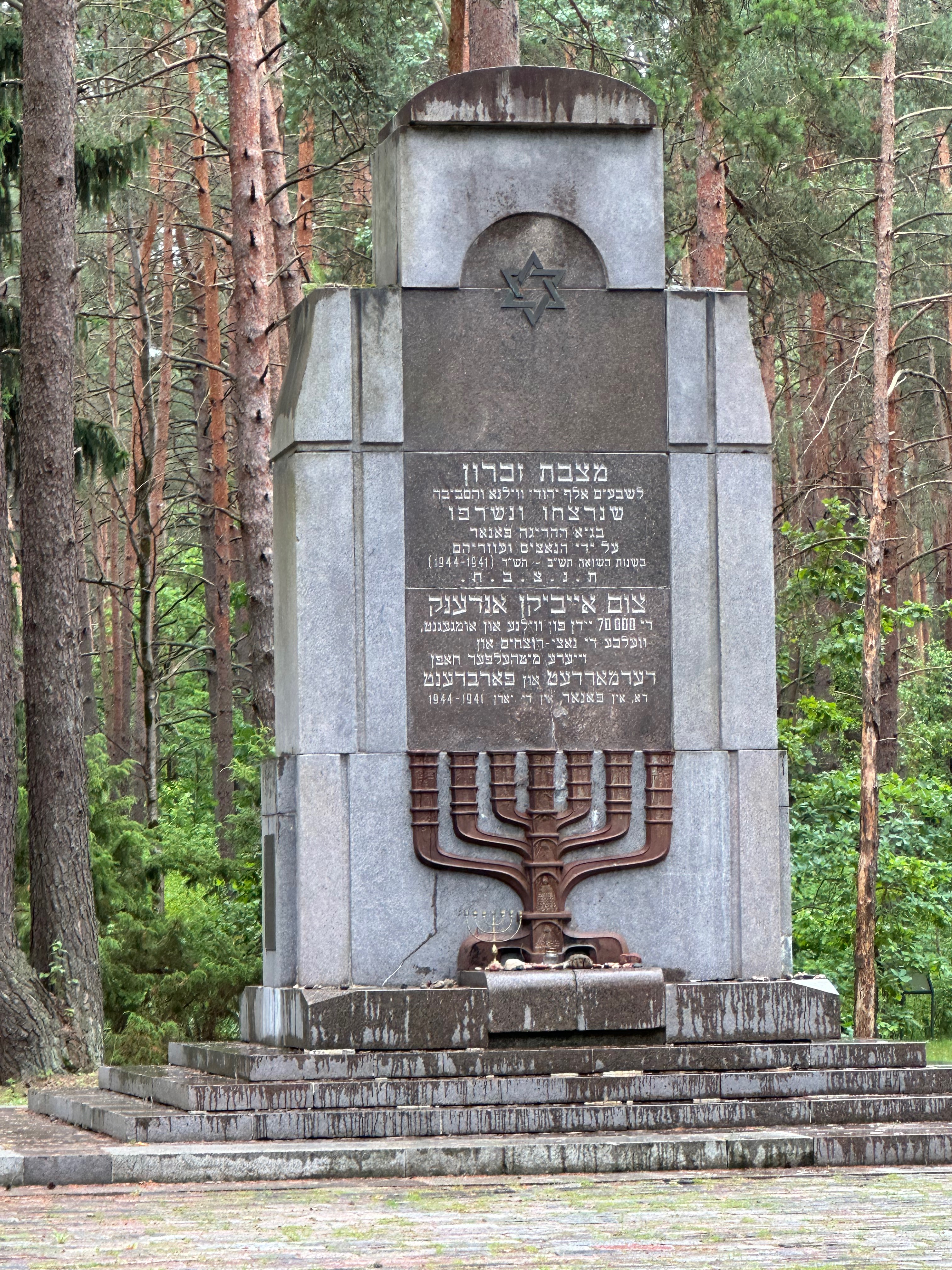
When the ghetto was liquidated the people were taken by truck about 20 minutes away to what was then the Ponary Forest, now the Paneriai Memorial. There the Nazis had discovered large pits used by the Russians to hold fuel and other materials, perfect for the mass graves. 70,000 Jews were murdered here along with 2,000 Poles, 8,000 Soviet POWs, and other people deemed traitors to the Germans.

The mass killings in Ponar were prior to the final solution of the concentrations camps and are not as well known. Here is a testimony from a gentleman who escaped. "Completely by Chance"

Although some of the pits were burned, remains still sit under the earth. In 2021 researchers used non-invasive geophysical methods to locate remains, as well as a tunnel that was used by those burning the pits to escape in the middle of the night. 12 of those prisoners were able to escape the forest. 

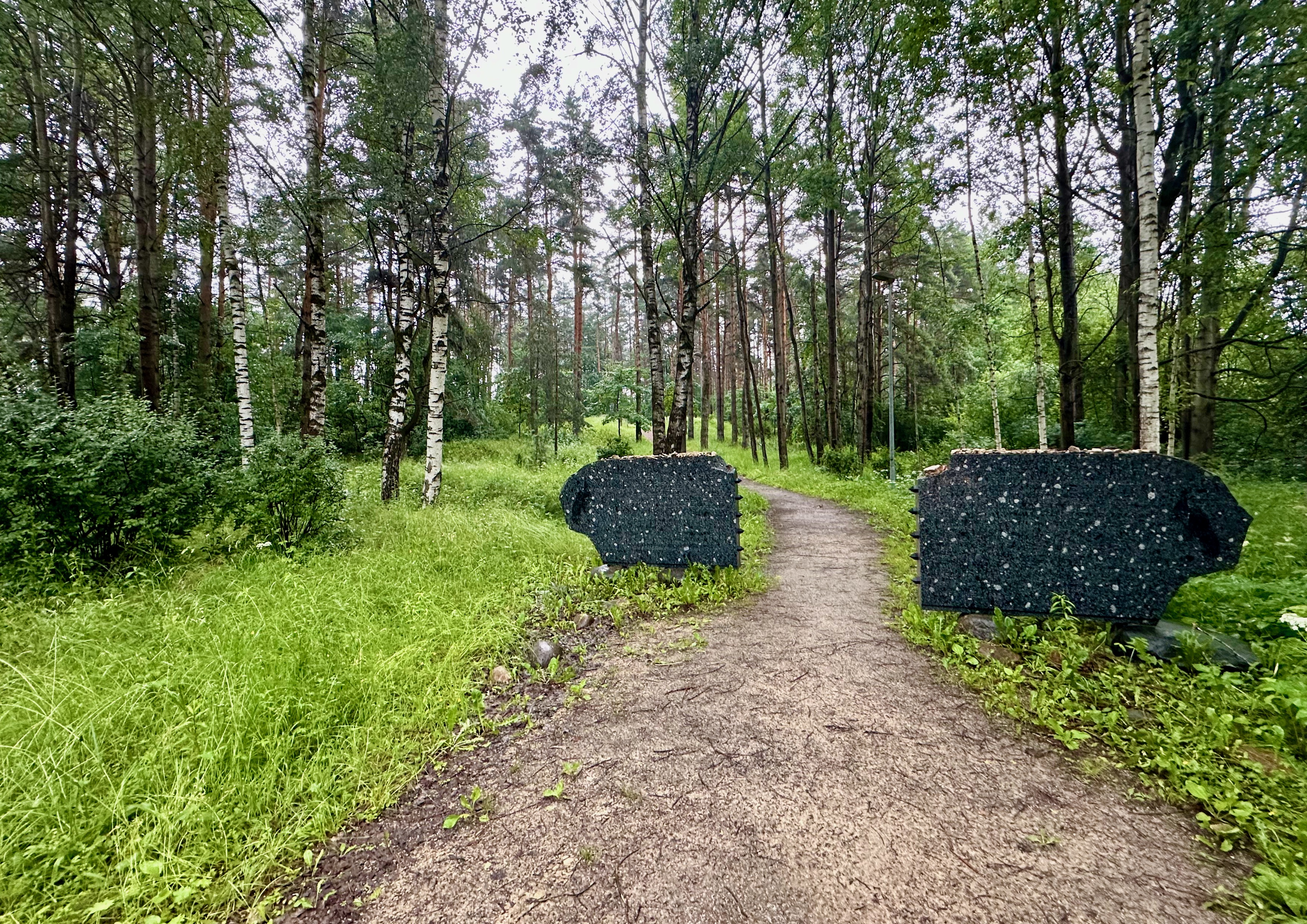
The beauty and quiet of the forest belied its history. Our walk through the killing fields was emotional, and when we saw a local walking through the woods to gather fresh strawberries that fill the area, it simply felt wrong. 


The original memorial had no mention of the Jews and other victims of the Holocaust,
only a mention of the Soviet POWs. That memorial stone was cut in half and a new memorial
plaque was added honoring all those who perished in Ponary (original name of the area).


Memorial Stone for the Jewish victims


This young man was found with documents identifying him. 
It was decided to place a gravesite with his photo as a symbol of all of those who perished. 


Our guide, Svetlana


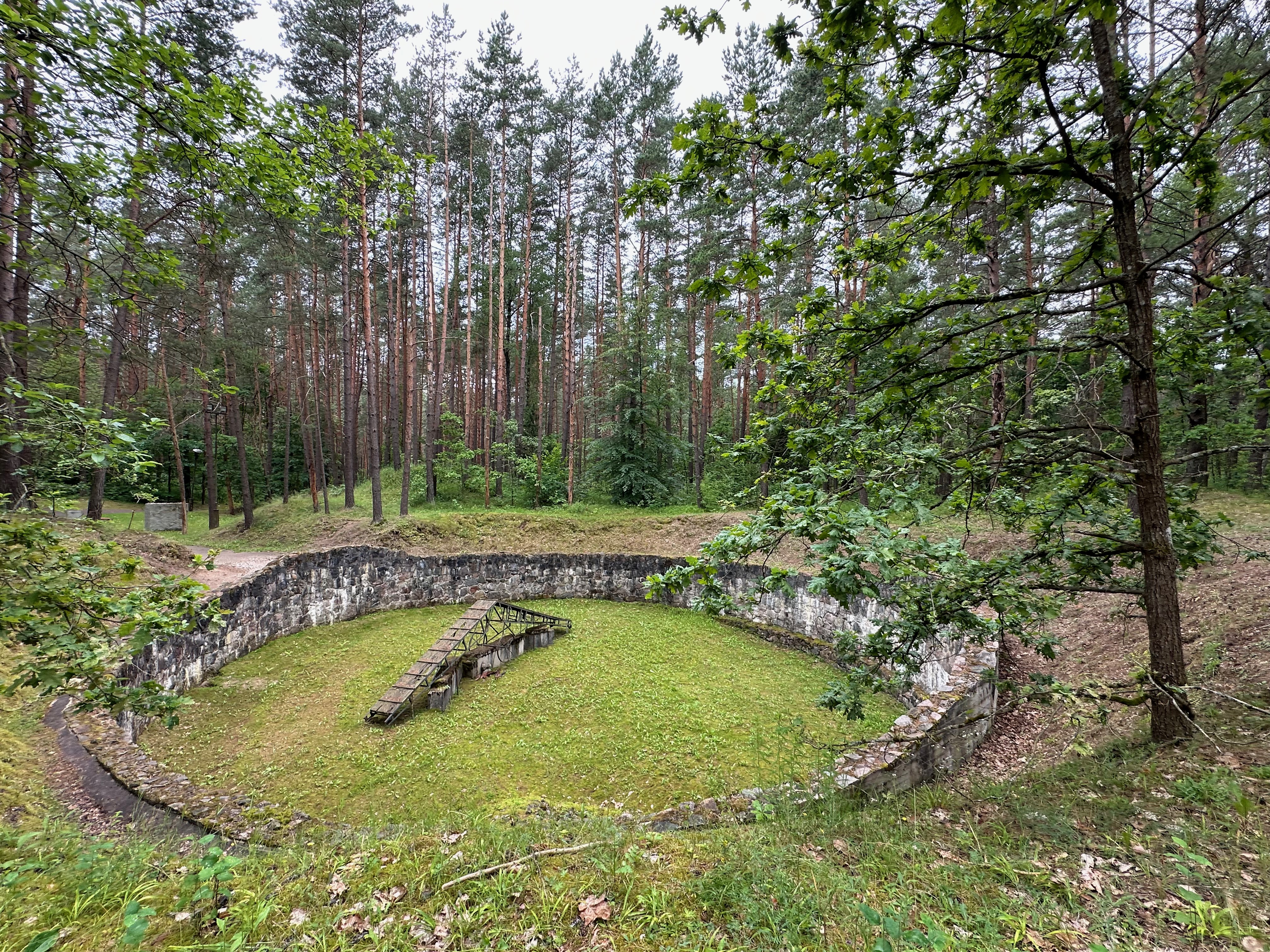
The largest pit


As it became clear that the Germans were losing the war, it was decided to burn the bodies
to remove any trace of the atrocities. Jewish prisoners were brought into the forest to do the job.
The wooden ramp was used to pile alternating layers of bodies and fuel for the fire.
The fire builders slept in this pit, digging a tunnel for days in order to escape, which they finally did. 
A guard eventually discovered the attempted escape and shooting ensued.
Twelve prisoners were able to reach the end to their freedom. 


I am purposefully ending this post on a positive note. Here is one of the most famous individuals, at least to Canadians and Americans, with roots in Vilnius. 


Leonard Cohen
Canadian-American Artist
Old Town Vilnius


Saturday, June 22, 2024

Friday Night Shabbat in Vilnius

Sundown last night was 9:45 p.m. Since we had made arrangements with Rabbi Sholom Krinsky at the Chabad of Vilnius to attend Shabbat services at the Great Choral Synagogue Friday night followed by dinner at Chabad, I was worried about the timing. Would we be eating dinner at 11 pm? I was relieved to learn that services started at 8 (or at least that was the theory). We arrived a few minutes before 8 and ran into a nice-looking young man (probably about my son's age, although that seems so young now) who welcomed us and showed us around the shul. The synagogue, built in the Romanesque-Moorish style, dates to 1903. It is the only one of about 100 synagogues that existed before World War II. During the Nazi regime is was used to house medical and other supplies.


The bimah and the Arom HaKodesh
One gentleman with tefillin davening afternoon prayers


A view from the back of the synagogue

By 8 there were 3 people in the synagogue besides Beth and me, and we don't count as a minyan. In case you might know know what a minyan is, it defines that prayer cannot take place without 10 people; in Orthodoxy, that means 10 men. Beth and I were escorted upstairs to the women's section, the only two women who would attend services that evening. The cantor arrived around 8:10 and the rabbi around 8:20, but, still, there weren't 10 men in the building. This gave us an opportunity to take some photos from a different perspective. 


The bimah from the women's section


A view of the ceiling


An unusual aspect of the synagogue is the old matzah-making machine for Passover that sits in the women's section. The congregation makes its own matzah for sale to the local Jewish community of about 500 people. Some reviews online suggested that the machine is no longer used, but our guide the following morning said that her family only goes to the synagogue once a year -- to buy the matzah for Passover.


Matzah-making machine

By 8:30 there were a few more than 10 men present, and the service began with the cantor chanting Mincha, the afternoon service. I was enthralled with his passion, hands moving up to embrace G-d and out to welcome Him in. Finally, Rabbi Krinsky stepped up to the bimah and spoke in Lithuanian for a few minutes, so neither of us had any idea about what he was saying. That was followed by the evening service. Several of the other men contributed by reading prayers, and we noticed that some of them had paper copies of a transliteration of the siddur. The service was brief, and soon we were all walking together for about 15 minutes to the Chabad House for Shabbat dinner.

Since the candles had already been lit and the prayers recited, I was no longer able to take photos, but the evening was pure chaos. The rabbi has four children -- two young adults and two young ones. His assistant, the schlicha from Israel, and his pregnant wife has four little ones and a former Vilnius resident and his Russian wife brought who return to Vilnius every summer had one adorable 2 year old. And they all liked to scream, cry, play soccer, run around, and scream some more. Later another 3 or 4 children arrived with their young families who had not been to services adding the the chaos. At the end of the evening, as the rabbi was attempting to lead birkat hamazon, the prayer said after a meal in which people congregate, the rabbi and I were exchanging frustrated glances. By the way, the rabbi is from Boston and his wife from Brooklyn, but they have been in Vilnius for thirty years. Their lovely daughter who occupied most of our conversation for the evening is on her way back to Brooklyn to make a life for herself there.

After birkat hamazon the rabbi and his wife walked Beth and me back to our hotel, just a short 10 minute walk from the Chabad House. It was a raucous evening with good food, way too much food (I thought the appetizers were dinner and filled up before the matzo ball soup), and a unique experience. Had we not gone to services, we would not have been able to visit the interior of the synagogue since it is closed to the public on Saturdays. 


Daugavpils Synagogue and Jewish Latgale

As I mentioned in an earlier post, my great grandmother, Rose Deutch Dembowitz, emigrated from Dvinsk, then in the Russian Empire in the province of Vitebsk. The name of the city changed a number of times. The Germans called in Dinaburg; it was called Dvinsk during the Russian Empire; finally, after the second independence in 1991, it was given the name Daugavpils, meaning the "castle on the Dauga River." In 1917, when the area of Latgale was reunited with Latvia, Dvinsk became a part of the Latgale province. 

Around the time Rose left Dvinsk there were around 34 synagogues. Today there is one. Jews made up about 47% of the population of the city 1903. After a mass emigration at the turn of the 20th century and World War I, the Jewish population dwindled to 11,106 at the start of World War II. By the end of the war fewer than 100 people remained. Today about 500 Jews call Daugavpils home.


A map of Dunaberg (also spelled Dinaburg)
showing the location of the 34 synagogues 

You need an appointment to visit the Daugavpils Synagogue where a docent, usually the president of the synagogue who speaks Russian and what he calls "his beautiful English," shares the story of Jews in the city and takes you on a tour of the synagogue and the quite strange small museum upstairs. 


Exterior of the Daugavpils Synagogue


Our docent, Josif Rochko, has authored several books about Jewish life in Daugavpils and Latgale. Some of his commentary included Jewish rituals and objects that need no explanation to most Jewish tourists, but we appreciated his passion. Josif's father had lost his wife and children in the Holocaust, but he remarried, and Josif was born in 1949.


Josif Rochko pointing out the details of the Daugavpils Synagogue


The synagogue at 38 Cietoksna Street was not destroyed in World War II, but, like some others, was used for storage by the Nazi regime. Like many synagogues, the bimah sits in the middle of the room while the ark sits in the front on the Arom HaKodesh


Arom HaKodesh


Bimah


Upstairs was the strangest museum. As we walked up the steps it was more like walking into a combination junk store with all sorts of strange and ordinary household items. Rose Deutch, like her father Avram Yitzhak Deutch, was a tailor (identified on documents as a "tailoress") who, when she first arrived in Leeds, England and then Brooklyn, New York a year later, made her living sewing until she married. It was for this reason that I was drawn to an old sewing machine on which I could imagine Rose or Avram or Morris (Rose's older brother) working.


Sewing Machine in the Daugavpils Jewish Museum
Upstairs in the synagogue


The main part of the small museum consisted of photos tracing the history of the synagogue and the Jews of Daugavpils. There was a picture of Mark Rothko and his family as well as a photo of Josif Rochko's father. There was documentation of famous and not-so-famous Jews from Dvinsk/Daugavpils including Moshe Harel, the founder of Mossad and the composer Oscar Strok. 

The official name of the synagogue is Kadish, although it is believed that it is named for a person rather than the prayer. In 2005 the synagogue was restored with the funds donated by the children of Mark Rothko, and, on April 11, the president of Latvia, V. Vike-Freibergs, reopened the restored synagogue


Friday, June 21, 2024

From Dvinsk to Daugavpils

Introduction

When our driver picked us up at our Riga hotel he told us that he doesn't usually take anyone to Daugavpils, the second largest city in Latvia. That doesn't mean much since Riga has a population of about 635,000 while Daugavpils is 83,000. He wondered why we would choose to go to Daugavpils. We are here because our great grandmother, Rose Deutch, was from what was then known as Dvinsk. This small city has gone through a transformation from Daniburg during the German occupation (1275-1893), Dvinsk during the Russian Empire (1893-1920), and finally Daugavpils in 1920. The name remained during the Soviet occupation (1944 - 1991) and now, as an independent republic.

The story of the Jewish population is a somber one. When my Deutch family -- great grandmother Ann, great grandfather Avram, great uncle Morris (Moshe), great aunt Dora -- lived here there were about 32,000 Jews making up 46% of the population and 34 active synagogues. At the start of World War I, after the Deutch children all left for America, there were 11,106 (1935) Jews (14.6% of the population). After World War II there were about 2,200 Jews. Many successful Jews were deported to Siberia during the Soviet occupation including most of the shop owners. Today there is one synagogue and 70 Jewish people. 

The city is quite diverse, although Russian is the primary language here. When our great grandmother lived here (1886-1903) the family, like many other Jewish families, spoke Yiddish, a language with Germanic and Hebrew roots. Our tour guide's first language is Russian, and our guide at the synagogue (who is also its president) only speaks Russian with enough English to give a tour.

A Quick Look at Daugavpils Today

We took a two-hour walking tour of the city, known for its easy and slow lifestyle. A sculpture of a snail along their pedestrian street symbolizes life here.


Along Riga Street, the long pedestrian walkway


Close to the newly rebuilt Russian Orthodox Church that was demolished by the Soviets is a memorial to the victims of the Soviet Regime.


St. Alexander Nevsky Russian Orthodox Church
Original building (1864-1961) destroyed by the Soviets
Rebuilt and Consecrated on the same site in 2004.


Memorial to the Victims of the Red Regime


Daugavpils is a very green city. We visited several parks including Andrejas Pumpura, named for a writer of Latvian folklore. The two photos show the water fountain today and back at the time that our family lived here. Our guide at the synagogue told us that it was the favorite meeting place for Jewish families.


The original fountain in what was then Alexander Nevsky Gardens


Andrejas Pumpura Park
Statue of young girl with a lily


Dubrovin Park is named for the city's favorite mayor, Pavel Dubrovin (1839-1890), who created the park as part of his beautification plan in the late 19th century. A monument to him was erected in 2007, depicting him in a bowler's hat walking his  bulldog. The park is also the site of the only Soviet monument that was not destroyed after Latvia declared its independence. Since the memorial to seven Soviet officers who fought the Nazis in Daugavpils is also the burial site of the men, the monument was left standing. We came upon an enormous shield of Daugavpils created with flowers with a fleur de lys and a symbol of the now defunct castle for which Daugavpils ("castle on the Dauga River) is named. The aqua plants represent the Dauga River and the flowers, a city of parks. 


Pavel Dubrovin and his bulldog


Soviet War Memorial


Daugavpils Crest


Mark Rothko, a renowned American abstract artist, was born in Dvinsk, two years before my great grandmother emigrated from the city. His family (Rothkowitz) immigrated to the United States in 1913. His son and daughter created the Mark Rothko Museum in an old artillery building in the Daugavpils Fortress. Later, they also donated the funds to restore the only extant synagogue in the city -- Kadish Synagogue, usually referred to as the Daugavpils Synagogue. 


Mark Rothko Museum


Untitled, by Mark Rothko


Tomorrow's post will concentrate on the synagogue and Jewish life in Daugavpils (Dvinsk). It's time for Shabbat with services at the Vilnius Great Choral Synagogue and dinner at the Vilnius Chabad. 


Thursday, June 20, 2024

Jewish Riga

We spent most of the day exploring Jewish Riga with a local tour guide, Janis Riekstins. The first thing that surprised me was the resurgence of a Jewish population here, unlike Poland. Out of every 1,000 Latvians, 2.26 are Jewish. About 4,300 Jews call Latvia their home with 8,000 Jews having Jewish parents. 

Our first stop on the tour was a visit to an active synagogue, Peitav-Shul. It was built in 1905 in the art nouveau style of architecture with Egyptian and Assyrian motifs. Although the Nazis destroyed most of the synagogues in Latvia, the building is in the middle of Old Town Riga, making it too dangerous to burn down without destroying other buildings. Instead, the Germans removed the bimah and covered the ark with a wooden wall, burying the torahs and other religious books and artifacts behind it and used the building as a warehouse. 

When the wooden wall was removed after the war, the torahs were saved and brought back into use. During the Soviet occupation it was one of the only synagogues that was allowed to remain active. The current restoration of the synagogue was completed in 2005. The stained-glass windows are original to the building, and the paint reflects the original style, reflecting the Egyptian influence.


The art nouveau exterior of the synagogue


Original stained-glass windows


Interior of the Peitav-Shul


The Museum of the Riga Ghetto and Holcaust in Latvia revealed a history of Riga during World War II that was in some ways very much like the rest of Europe, but also with some surprises. The Germans took over most of the factories, but they needed cheap labor so they sent Jews from Lithuania, Austria, Germany, and Poland (including Auschwitz) to work. Similarly to the Plaszow Camp depicted in Schindler's List, the workers were confined to the Riga Ghetto. At one point over 30,000 Jews were living in the ghetto. 


A train car used to transport Jewish prisoners to work in the Riga factories


The story of Riga Jews originally confined to the ghetto


One room of the museum housed sketches by Aleksandra Belcova, 
a Russian-Latvian artist who witnessed the horrors of the Holocaust


A mural outside the Riga Ghetto Museum


Rather than transported to concentration camps, most of the Jews living in the Riga Ghetto were exterminated in two local forests. The Nazis dug trenches before marching the Jews to the forests where they were each shot with one bullet. The luckier ones died instantly, falling into the trench while others survived only to die later. There were some survivors, including a little boy who hid under the pile of clothes from the victims who were made to undress first. After the Nazis left, he ran to the local Catholic Church where the priests saved him by dressing him as a little Latvian boy and insisting that he was Christian. Rumbula Forest, closest to the ghetto, was the scene of the extermination of over 25,000 Jews. Although the Germans dug up the mass graves and incinerated the bodies, the Russians made sketches of the locations of the graves that were later used to build the memorial.


Memorial Stone at the entrance to Rumbula Forest


Path leading to the mass graves


Memorial on site of one of the mass graves


The other forest was a little further out of the city -- Bikernieuku Mezs. Here over 35,000 Jews as well as 700 patients from Riga's Psychiatric Hospital, political prisoners, and Soviet prisoners of war, were exterminated by the German Reich. The memorial includes 48 pits each with a single memorial stone as well as a central piece designed in the shape of the Star of David with stones representing victims and the cities from which they originated. 


Menorah surrounded by stones marking the people and cities of those murdered here,
forming the shape of the Star of David


A close-up of the stones and city -- in this case Stuttgart -- from which the victims originated.


Memorial with an ecumenical prayer, dedicated in January 2022


Most of our tour today was done in rain, which you can see from the rain-soaked memorials in the killing fields. When we passed what I thought was the remains of the Great Choral Synagogue, we stopped the car and viewed the scene from the window. In fact, the structure we were seeing was not the remains of the synagogue, but a memorial to its destruction. Destroyed by the Nazis, the building was burned to the ground. The little ruins that remained were buried underground. The memorial was built on the footprint of the original synagogue.


Memorial to the Great Choral Synagogue


Although at least one other synagogue building survived the Nazis, the Soviets only allowed the one to exist as a place of worship. This synagogue, one of the extant exterior structures, was turned into an apartment building, now in one of the poorer sections of the city. A Star of David originally surrounded six-sided window on the top of the synagogue which you can still see on the top here. 


Between the destruction by the Nazis and the Soviets, none of the Jewish cemeteries remain. Some contain broken headstones, but the Riga Old Jewish Cemetery is totally gone. Today it stands as a memorial park. 


Memorial headstone at the Old Jewish Cemetery


"This is Riga's first Jewish cemetery. It was opened in 1725 and burials continued here until the 
late 1930s. After German forces occupied Riga in 1941, the prayer house and the mortuary were burned down. The cemetery became a mass burial site for over 1,000 Jews killed in the streets 
and houses of the Riga Ghetto. Following World War II, many of the cemetery's tombstones were removed and used as building material. Others deteriorated. The wall surrounding the cemetery collapsed, and the site left uncared for fell into despair. In the 1960s the site was razed and renamed "The Park of the Communist Brigades." In 1992 the park was renamed "The Old Jewish Cemetery."


Zania and Johanna Lipkes were "Righteous Gentiles" Latvians who saved over 60 people from the Nazis by hiding them in a bunker under a storehouse on their farm. The Zania Lipkes Memorials is a museum dedicated to the couple, the others who helped them, and those who survived. The Lipkes lived close to the port on the Daugav River. It was Johanna who first considered hiding Jews at their home. Zania, who was at first hesitant, decided to help when he learned of the death of family friends in the Ghetto. As a smuggler who was also assigned to transfer people to and from the ghetto, giving him access to help people escape to his bunker. Zania and Johanna Lipkes have a memorial tree as part of the "Righteous Among the Nations." Watched by the Soviets, Zania had to smuggle himself out of Latvia in order to travel to Israel to accept his honor. 


A brief clip from a video of Johanna Lipkes giving testimony
about she and her husband hiding Jews from the ghetto.
The video runs at the bottom of the bunker so it is taken from above.
You will hear our guide talking about the daring rescues.


Although our exploration of Jewish Riga focused on the Holocaust and post-World War II, it was interesting to learn about the history of the Litvaks (Yiddish word for Latvian Jews) after my great grandmother left the area. Of course, at that time (she left in 1903), Dvinsk was a part of the Russian Empire. The first wave of Jewish emigration was during the pogroms. World War II was devastating to the Jews, and life under Soviet rule was harsh. But after Latvia became an independent republic in 1991, the population of Jews in Latvia began to grow, although in much smaller numbers than at the turn of the 20th century. 

Tuesday, June 18, 2024

Esam ieraduĊĦies: We Have Arrived.

On our journey to discover our family's ancestral homes, we are visiting the country's capitals, as well as some large cities such as Krakow, Poland. Our first stop is Riga, the capital of Latvia and the largest city in the Baltics. Our hotel, in the center of Old Town, is a historic building dating to the 18th century. The original wooden building was home to Bishop Albert in the 13th century. After it was destroyed in a fire in the 17th century, the current brick structure was built on the site. Renovations take advantage of the brick, and the rooms are spacious. Although the hotel has modern amenities, the furniture looks like it comes from the 18th century. 


Our room in the Hotel Justus 


The spiral staircase


Fun murals throughout the hotel


A walk around Old Town Riga revealed enough bars to go to a different one every day for a month as well as numerous restaurants, with some offering traditional Latvian food, like the one we chose. Dinner included traditional potato pancakes which tasted exactly like latkes when fried correctly. The Latvian meatballs, made from pork, were enormous. Latvia is known for their beers and ciders so we had to taste one of each. The rye bread pudding was probably an acquired taste.


Traditional Latvian meatballs, potato pancakes, chokeberry cider (aroniju)

In 1989, when Latvia was still under Soviet control, people in the country joined hands with citizens from Lithuania and Estonia, a human chain that served as a "powerful message to the world and a symbol of solidarity among the Baltic States." Remarkably, within six month of this transformative protest, on March 11 (my birthday), 1990, Latvia declared its independence, becoming the first of the Soviet Republics to do so.


Riga Opera House

Tomorrow is the first day that we explore our Jewish heritage in Latvia. Although my great grandmother, Rose Deutch Dembowitz, did not come from Riga, but from Dvink (Daugavpils), a three-hour drive from the capital, we hope to learn more about the life of Jews in Latvia. We habe a five-hour tour that includes two synagogues, the Jewish Ghetto Museum, and various sites of mass murder during the Holocaust. We are grateful that our family emigrated before World War I.


Searching for the Braufenbreners (Brenners): Frampol and Shebershin (Yiddish) Szczebzreszyn

  Direction sign on our visit to the Braufenbrener and Waldman  ancestral homes I was never much interested in genealogy nor my family histo...